
Joint Health: Stay Active and Injury-Free
Discover effective fitness tips to maintain joint health and prevent injuries as the seasons change. Learn how to keep your body in spring shape and ensure it stays ready to move.
HEALTH TIPSWOMENS HEALTHFITNESSINJURY PREVENTION
Natasha B. Taylor
5/4/20269 min read


The Moment Michigan Runners Come Alive
If you live somewhere that has real winters and those of us in Michigan absolutely do, you know the feeling.
The temperature creeps above 40 degrees for the first time in months. The sun actually stays out past 5pm. And something inside you wakes up right along with it.
For me that feeling means one thing: I want to run outside.
I am not a cold weather runner. I will say that plainly and without apology. When the temperatures drop I am not the person bundling up and hitting the pavement. I do not run outside in cold weather. Full stop. And the treadmil
does a number on my knees in a way that outdoor running simply does not. Something about the repetitive, unchanging surface and the slight forward pull of the belt changes my gait enough that my knees feel it. So winter running and I have an understanding. We do not see each other until spring.
Which means that every year around this time I find myself in the same position most of my patients and clients find themselves in eager, motivated, and returning to outdoor movement after months away from it.
This year was different though. And I want to tell you about it because what happened a few days ago on a warmer-than-usual Michigan afternoon taught me something I already knew clinically but felt personally for the first time in a while.
I’m going to feel this 5K!
I am a self proclaimed, retired sprinter so running 5K is nothing for some but considered a long run for these thighs. But in my over-achiever fashion, I signed up to be part of a relay marathon during the October 2026 Detroit Marathon. Having a goal on the calendar changes everything about how you train and forces me to be consistent with running but since I am not sure how long my leg of the race will be, I decided to follow a 10K running program which helps me get in one to two runs per week.
Two days ago the program called for a 5K.
A full 5K. Outside. The first real outdoor run of the season.
I want to be honest with you about what was going through my mind leading up to it.
My knee is going to hurt. My ankles are going to feel like concrete. My muscles are going to be so tight.
I know my body and I knew what returning to outdoor running after a winter break typically feels like. I had every reason to expect some degree of stiffness, achiness, or that familiar sensation in my knee that reminds me it has a history.
So I did a quick warm-up. I waited for a warmer day. And I went outside and ran the 5K.
And my body did not hurt.
Not my knee. Not my ankles. Not my muscles. I finished and stood there genuinely surprised, and then almost immediately I understood exactly why.
Yoga. Consistent, intentional mobility work. Two to three times a week for the past several months.
What Yoga Did That I Did Not Expect
Here is some context. I enrolled in a yoga teacher training course (another over-achiever activity) not primarily as a runner or even as a PT, but as a continuation of my own personal wellness journey. The training requires a certain number of practice hours and as a result I have been doing more yoga and mobility work than usual. At minimum two to three sessions per week of intentional stretching, breathing, and moving my body through its full range of motion.
I have not been doing intense strength training during this period. I have maintained two to three days per week of resistance training, spin high intensity cardio with this the logical addition to my routine has been yoga and mobility.
And that addition is what carried me through a 5K with no pain after months of limited outdoor running.
I share this not to prescribe yoga for everyone but to make a point that I think gets lost in fitness conversations.
Mobility is not a warm-up. It is not optional. It is not what you do when you have extra time.
For women over 40 returning to outdoor activity after winter, consistent mobility work may be the single most important thing separating a smooth spring season from an injury that sidelines you for weeks.
“I’m Telling You, The Weather Has Something to Do With My Knee Pain”
I hear this constantly in my practice. Patients usually said with a mix of conviction and mild defensiveness, as if they expect me to dismiss them.
I never dismiss them. Because they are right.
I want to be transparent here I personally do not feel significant joint pain when the weather changes. My body does not serve as a barometer the way some of my patients describe. But I have heard this enough, and the physiology behind it is clear enough, that I take it seriously every single time.
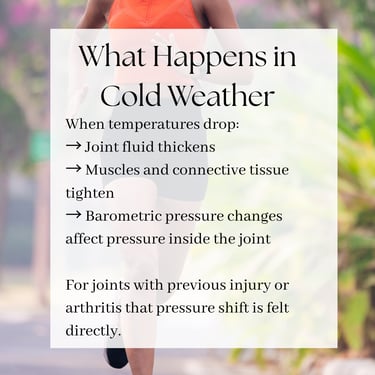
Here is what is actually happening in the body when temperatures drop and barometric pressure shifts:
The synovial fluid inside your joints, the natural lubricant that keeps movement smooth, becomes more viscous in cold temperatures. Think of it like oil in a car engine on a cold morning. It thickens. Movement becomes less fluid and more effortful as a result.
The muscles, tendons, and connective tissue surrounding your joints tighten in cold weather as a protective response. Your body is quite literally bracing itself. That bracing reduces range of motion and increases the perception of stiffness and discomfort especially in joints that already have some history, whether that is arthritis, a previous injury, or general wear over time.
And then there is barometric pressure. When a storm front moves in and atmospheric pressure drops, the pressure inside the joint capsule responds. For joints with any degree of inflammation or sensitivity, that pressure change is felt directly and meaningfully. Your knee is not predicting rain out of intuition. It is responding to physics.
So the next time someone or you says the weather is affecting your joints, the answer is yes. It absolutely is. And that is not in your head.
What Winter Does to the Body Beyond the Cold
Here is the piece of this conversation that does not get enough attention.
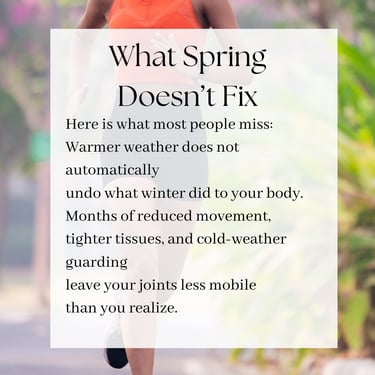
Even if you stayed active all winter, gym sessions, indoor cycling, home workouts, your body has been operating in a constrained movement environment for months. And that has consequences that warmer weather does not automatically undo.
You have been moving in less varied ways. Outdoor movement, especially walking and running on natural terrain engages stabilizing muscles, challenges your balance, and moves your joints through ranges of motion that flat indoor surfaces simply do not replicate. Months of gym floors and treadmills leave certain muscles underworked and certain movement patterns rusty.
You have been sitting more. Even the most active people tend to sit more in winter. More time indoors, more time on the couch, more time at the desk under blankets. Prolonged sitting tightens hip flexors, weakens glutes, and compresses the lumbar spine in ways that show up as stiffness and pain when you suddenly ask your body to perform at spring levels.
Your ankle mobility has likely decreased. This is one of the most underappreciated winter casualties. Wearing heavier, more supportive footwear and moving less over varied terrain reduces ankle mobility over months. Restricted ankles change the load on your knees and hips with every step and that compensation multiplies quickly once you are logging outdoor miles or hours in the garden.
Vitamin D levels have dropped. For those of us in northern climates, winter means significantly reduced sun exposure. Vitamin D plays a direct role in muscle function, immune response, and mood regulation. Low levels contribute to the fatigue and general heaviness that many people feel heading out of winter and that fatigue affects movement quality more than most people realize.
The cumulative effect of all of this is a body that feels ready for spring — because the motivation and the mood are genuinely there — but that needs a intentional transition period before it performs at spring and summer levels.
Spring is not a reset button. It is a starting line.
The Spring Readiness Body Check
Before you commit fully to outdoor running, long walks, or weekends in the garden — here are three things I recommend assessing at home. These are the same movement screens I use with patients returning to outdoor activity after winter.
1. Single leg balance Stand on one foot without holding onto anything. Hold for ten seconds. Switch sides. Notice whether one side feels significantly less stable than the other. That instability reflects how well your nervous system is communicating with the stabilizing muscles of your hip, knee, and ankle. If one side feels noticeably wobbly, that leg needs some attention before you ask it to carry you through miles of uneven outdoor terrain.
2. Ankle mobility Stand facing a wall with your foot placed about four inches from the baseboard. Drive your knee forward toward the wall, keeping your heel flat on the floor. Can your knee reach the wall without your heel lifting? If not, your ankle mobility is restricted — and restricted ankles shift load directly onto your knees and hips with every step you take outdoors.
3. Squat pattern Perform a slow, controlled bodyweight squat with your feet shoulder width apart. Watch for knees caving inward, heels lifting off the ground, or a significant forward lean of your trunk. These are movement compensations that your body has developed to work around weakness or restriction somewhere in the chain. They feel manageable in controlled settings. They multiply under the distance and variability of outdoor activity.
If any of these feel off — that is not a reason to pause your spring plans. It is simply information. Information you can act on before asking your body to perform at a level it is not yet prepared for.
A Simple Transition Plan for the First Few Weeks of Spring
The goal is not to hold yourself back. The goal is to build into spring activity in a way that keeps you moving all season instead of sidelining you in week two.
Here is what I recommend for the first two to three weeks:
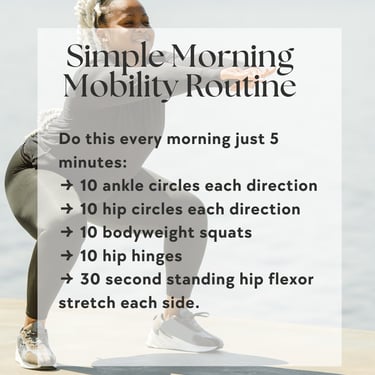
Daily morning mobility — five minutes: Ten ankle circles in each direction. Ten slow hip circles. Ten bodyweight squats with intentional attention to form. Ten hip hinges. A thirty second hip flexor stretch on each side. This does not require a mat, a gym, or any equipment. It requires five minutes and the intention to prepare your body before you ask it to perform.
Progress your outdoor activity gradually: If you are returning to running, start with a run-walk interval rather than a full continuous effort. If you are walking, add distance slowly over two weeks rather than doubling it on the first warm weekend. If you are gardening — and I will address this in depth next week — treat your first sessions as physical activity that requires warm-up and recovery, not just a weekend chore.
Add intentional mobility work two to three times per week: Yoga, stretching, foam rolling, or a dedicated mobility session. My 5K two days ago is the most personal evidence I can offer you for why this matters. The strength training maintained my foundation. The yoga kept my joints ready. Together they got me through a first outdoor run of the season with no pain.
That combination — strength plus mobility — is the formula I come back to again and again for women over 40 who want to stay active without constantly managing injury.
Your Body Is Ready. Let’s Make Sure It Stays That Way.
Here in Michigan we earn our springs. After months of grey skies and cold mornings, the first warm days feel like a gift and every instinct says go get outside, move, do all the things you have been waiting to do.
I am right there with you. I felt it two days ago lacing up for that 5K. I will feel it again the next time the sun comes out and my running program calls for more miles.
But what I know personally and professionally is that the women who thrive through spring and summer activity are the ones who treat the transition intentionally. Who warm up before they go. Who add mobility work to their weekly routine not because they are injured but because they want to stay that way. Who listen to what their body is telling them and respond with preparation rather than pushing through.
Your joints are not your enemy. Your motivation is not the problem. The bridge between the two is preparation.
And the beautiful thing is that preparation does not have to be complicated. Five minutes in the morning. Two yoga sessions a week. A gradual return to the movement you love.
That is what got me through my 5K pain-free. It can do the same for you. 🖤
Not sure where your body stands heading into spring? I offer virtual movement assessments for exactly this — a personalized look at how you are moving and what to address before outdoor activity picks back up. Send me a message and let’s get you ready for the season.
Drop a comment below — are you a spring runner? A gardener? A walker? Tell me what outdoor activity you are most excited to get back to and I will share specific prep tips for exactly that.
Natasha Taylor is a physical therapist, online fitness coach and founder of Black Star Physical Therapy & Wellness. She helps women over 40 manage pain, prevent injury, and build strength that lasts through every season.
@blackstar_ptwellness on Instagram | Facebook | YouTube
Your simple morning Mobility Routine

Contact
Get in touch
Follow
Connect
info@blackstarwellness.com
734-644-3293
© 2025. All rights reserved.